When Care Moves Home, Complexity Shouldn’t Follow
MedArrive was built by healthcare operators who experienced firsthand what it takes to move care beyond the hospital, and this series features the people carrying that foundation forward. Read on to learn how our leaders' experiences continue to shape the platform and why operational intelligence is critical to the future of healthcare. Next up, Head of Business Development Operations, Katie Heimbichner.
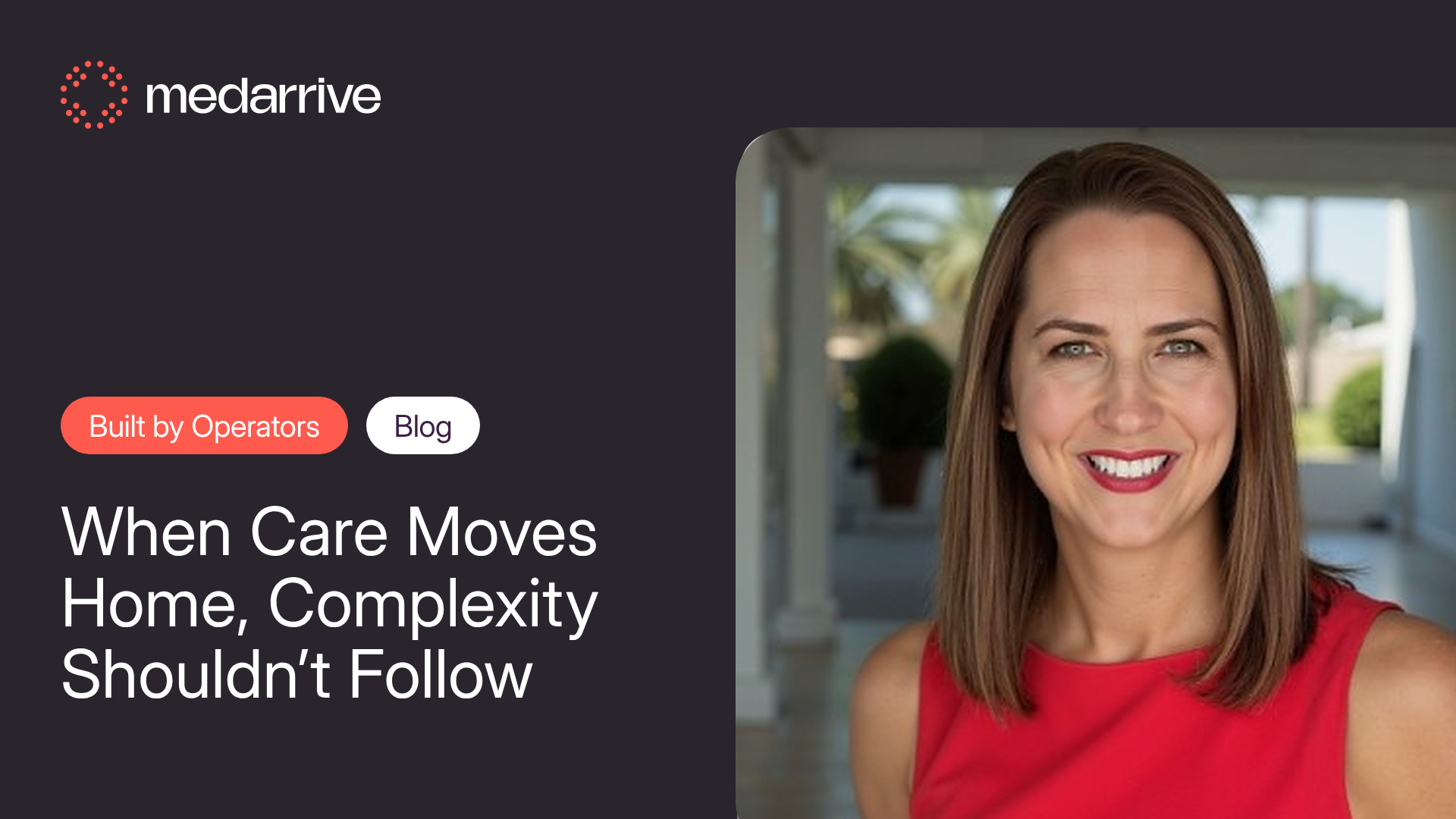
My path into healthcare wasn’t a traditional one. I came from banking and finance, but one of the experiences that most influences my work at MedArrive came from watching my son work in assisted living and acute rehabilitation.
He started at 15 and is now in nursing school. From his vantage point, I saw how the complexity of healthcare eventually reaches the people closest to the patient. Physical therapists, occupational therapists, nurses and other members of the care team are all trying to do good work. But sometimes everyone arrives at once. Sometimes no one arrives. At times, the people responsible for holding the pieces together feel almost invisible themselves.
That experience stays with me when I talk with healthcare organizations today.
For too long, we have assumed that meaningful care must happen within a hospital or another brick-and-mortar facility. But home can be a more comfortable and supportive setting for patients and families, while preserving hospital resources for people who truly need acute care.
The challenge is ensuring that when care moves home, the system’s complexity does not move home with it.
People who have not performed this work often underestimate what it takes. Every patient, family and care plan is different. Moving someone to the next site of care may require dozens of interdependent actions. The appropriate provider must be identified. Coverage, capacity and equipment may need to be confirmed. Visits must be scheduled in the right sequence. Patients and caregivers need to know who is coming, when they will arrive and what happens next.
From the outside, it can look like a scheduling problem. Inside healthcare organizations, it is often managed through team chats, Post-it notes, text messages, spreadsheets and conversations across cubicle walls. It's a broader logistics issue that the MedArrive team experienced firsthand; one we were driven to solve, and the reason we developed the platform.
One example I share with customers always draws knowing looks, laughs and nods. A care manager on one hospital floor may be calling three facilities to locate a bed for two patients. Meanwhile, another care manager upstairs is calling those same three facilities for different patients. At the other end, each facility is fielding dozens of overlapping calls from the same hospital, plus dozens more from others.
No one in that process is failing to work hard. The operating model simply makes it unnecessarily difficult for people to work together.
That is why MedArrive is focused on more than scheduling. We help healthcare organizations identify the right patients earlier, determine the most appropriate next site of care, understand available capacity and coordinate the people and resources required to make the transition happen.
We think deeply about what the experience feels like once a patient is home, because continuity matters. A patient feels more seen and known when familiar caregivers walk through the door. A family member feels more confident when the schedule is clear and the care team is coordinated. Removing the uncertainty around who is coming and what happens next can make an already stressful experience much more manageable.
My work with customers reinforces another important lesson: practical healthcare technology must be built through partnership. Organizations do not need another rigid product that forces their teams into someone else’s workflow. They need a solution that reflects their terminology, operating model and real-world needs.
That is an advantage of MedArrive’s operator mindset. We work alongside customers, listen closely, configure the platform around their environment and adapt as we learn their unique workflows and needs, together.
When healthcare organizations remove operational friction, care teams can spend less time tracking down information and more time helping patients. Hospitals can focus their beds and resources on those who need them most. Families can spend less time managing logistics. And patients can receive coordinated care in the place many would most like to be: home.
To me, being built by operators means never losing sight of the people who experience the consequences of every workflow and handoff. Technology creates real value when it makes care not only more efficient, but more coordinated, personal and human.