The Best Healthcare Technology Knows It Isn’t the Only System
MedArrive was built by healthcare operators who experienced firsthand what it takes to move care beyond the hospital. In this series, the people carrying that foundation forward share how their unique perspectives shape the platform and why operational intelligence is critical to healthcare’s future. In the next installment, CTO, Pete Burns shares his point of view.
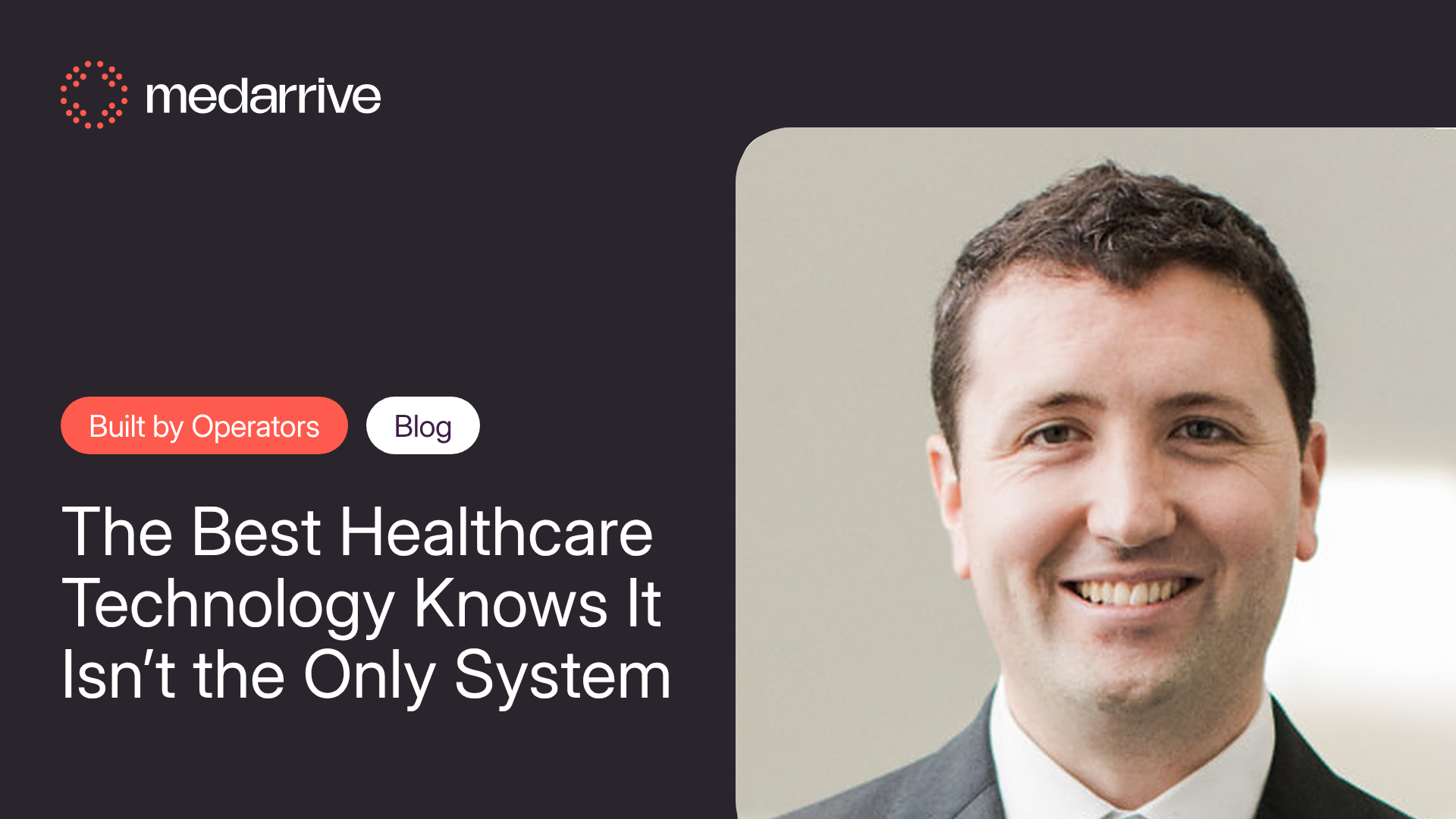
I started my healthcare technology career at Epic more than 20 years ago, working with teams focused on clinical documentation in outpatient and anesthesia settings. That experience gave me an early appreciation for the scale and complexity of enterprise healthcare technology.
It also taught me something that still shapes how I approach product development today: no technology operates in isolation.
Healthcare organizations rely on deeply embedded systems that have accumulated decades of important capabilities. Replacing them is difficult, not because any single function is impossible to reproduce, but because there are thousands of details that must work correctly for thousands of different users.
The most effective healthcare technology recognizes that reality. It does not enter an organization assuming it can redesign everything from scratch. It identifies the places where specialized technology can solve an important problem, then works responsibly within the broader ecosystem.
Build for the environment that exists
This matters especially in home-based care.
Most healthcare technology was originally designed around a familiar model: the patient travels to a brick-and-mortar location where the clinicians, equipment and systems already are.
Care in the home reverses that model. Now the people, information and resources required to deliver care must move to the patient. That introduces a completely different set of operational challenges, and many organizations are still trying to manage them with paper, spreadsheets, manually plotted maps or tools designed for a clinic.
Technology can help, but only if it reflects how the work is actually performed.
People who are new to healthcare technology sometimes assume that an inefficient workflow can simply be redesigned. In reality, healthcare processes exist for many different reasons. Some reflect clinical, regulatory or operational requirements. Others persist because of organizational history. Even from inside an organization, it can be difficult to distinguish between the two.
Either way, change is rarely simple.
That is why we design MedArrive to be configurable. Certain fundamentals remain consistent: there are patients, clinicians, encounters and locations. But the way those elements come together can vary significantly by customer and use case.
The duration of an appointment may differ. The scheduling workflow may differ. The systems involved before, during and after the visit may differ. Building for home-based care means accounting for that variation without losing the underlying structure required to operate efficiently.
Integration cannot be an afterthought
Even a seemingly straightforward task like scheduling a patient may involve several systems.
A call center or customer relationship management platform might support the initial outreach. MedArrive may manage scheduling and routing. The electronic health record remains the destination for clinical documentation. Another platform may send reminders or other communications to the patient.
That means a single operational workflow can require three or more interfaces before the visit even takes place.
Integration cannot be something a technology company considers after the core product has been built. It has to influence the architecture from the start.
For MedArrive, that means being flexible about how we receive information, how we return it and how our workflows interact with the rest of a customer’s environment. Our platform should be a good citizen within that ecosystem, making the systems and teams around it more effective.
AI is a tool, not the objective
The same problem-first thinking applies to AI.
Healthcare has used forms of artificial intelligence for years. What is especially compelling about today’s large language models is their ability to process large amounts of unstructured or semi-structured information and produce useful results. That makes previously difficult problems easier to address and dramatically changes the speed at which certain solutions can be developed.
But AI does not change the purpose of what we are building.
If someone is selling a product simply because it uses AI, I think they have lost the thread. The objective is to solve a meaningful problem. AI is a powerful new tool that expands the range of problems we can solve, but the value comes from the outcome, not the label.
At MedArrive, we stay focused on the operational problems that make delivering care at home harder than it should be. We use technology, including AI, where it can remove friction, improve visibility and help people work more effectively.
Making care at home practical at scale
Ultimately, the purpose of building technology is to solve problems.
For MedArrive, that means making care in the home more efficient and practical, even at scale. It means helping organizations move beyond spreadsheets, manual processes and disconnected tools so they can coordinate more patients, clinicians and visits without adding complexity at the same rate.
Doing that well requires more than understanding software. It requires understanding the systems, workflows and constraints already shaping how healthcare operates.
The best technology does not ask customers to enter an imaginary, perfectly designed world. It meets them in the real one and helps them make it work better.